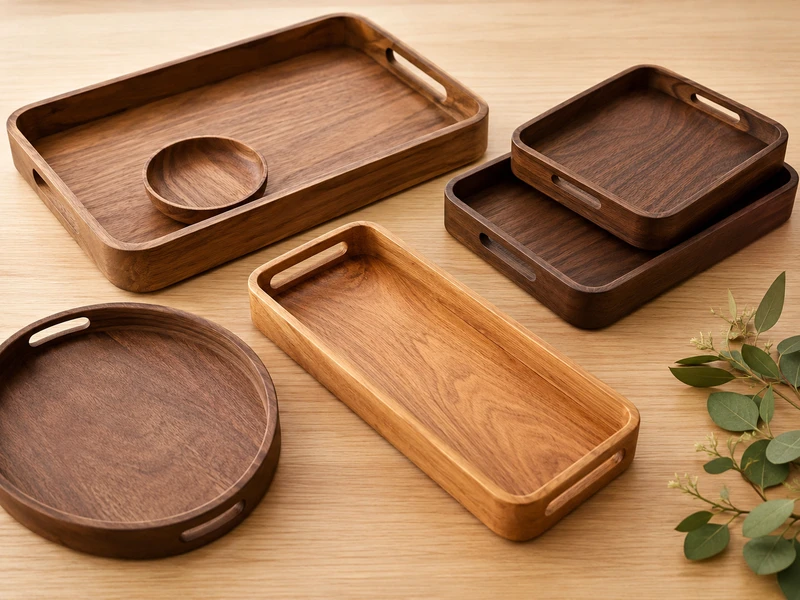
A hotel buyer recently asked for 3,000 wooden breakfast trays with handles, anti-slip bases, and food-safe finishes. The trays needed to stack efficiently for housekeeping storage and survive daily use with hot plates and wet glasses. That request sounds simple, but the production details — handle attachment method, anti-slip material, food-safe coating type, and stacking clearance — are where most suppliers fall short.
Wooden trays look straightforward, but functional details matter more than appearance. A beautiful tray with a weak handle or an uneven base will fail in real-world use. This guide covers what buyers should know before sourcing custom wooden trays.
Functional Details Buyers Often Miss
During sample development, buyers often discover details they didn't think to specify. These are the most common:
- Handle attachment — cut-out handles are integrated and strong, but reduce the tray's usable surface. Rope handles look good but must be knotted securely on the underside. Metal handles are durable but add cost and require precise hole placement.
- Edge height — 1cm low-profile for display trays, 2-3cm for serving trays, 4-5cm for deep trays. Edge height affects both function and appearance.
- Anti-slip base — rubber feet, felt pads, or cork base. Prevents scratching on tables and keeps the tray stable. Without this, trays slide on polished surfaces.
- Flatness — wooden trays can warp if the wood moisture content is not controlled. Ask about moisture content standards and warpage tolerance.
- Stacking clearance — trays that stack for storage need consistent depth and no protruding hardware. A 2mm variation in depth makes stacking unstable.
Practical Example: Hotel Tray with Anti-Slip Base
A boutique hotel chain ordered 2,000 breakfast trays (35×25cm, 3cm edge) with rope handles and anti-slip bases. The first sample had felt pads that peeled off after 5 uses. The second sample used cork base — durable but added 3mm to the tray height, making stacking unstable. The final solution: recessed rubber feet pressed into drilled holes, flush with the tray bottom. Durable, stackable, and scratch-proof.
Popular Tray Structures
- Flat serving trays — classic design for food and drink service. Available in rectangular, round, oval, and custom shapes.
- Raised-edge trays — 1-3cm edges prevent items from sliding. Good for carrying condiments, drinks, and small items.
- Handled trays — easy to carry and serve. Popular for breakfast service and room service in hotels.
- Compartment trays — built-in dividers for condiment sets, spice collections, or product displays.
- Display trays — shallow trays for retail product display and countertop merchandising.
- Nesting trays — designed to stack inside each other for efficient storage and shipping.
Food-Safe Finishes
For serving and dining trays, food-safe finishes are essential. FDA-compliant coatings include food-safe oils, water-based lacquers, and wax finishes. Each has different durability and maintenance characteristics. Oil finishes are easy to reapply but need regular maintenance. Lacquers are more durable but harder to repair if scratched. Ask your supplier for food-safety documentation if you export to markets with strict regulations.
Wood Selection for Trays
- Beech — hard, durable, fine-grained. The top choice for premium serving trays. Food-safe and long-lasting.
- Birch — smooth surface, consistent grain. Good for laser engraving and clean painted finishes.
- Bamboo — sustainable and strong. Naturally food-safe with proper finishing. Popular for eco-conscious brands.
- Rubber wood — hard, stable, sustainable. Good value for solid wood trays. Takes stain and paint well.
Stacking and Export Packing
Trays stack naturally, but packing for export requires careful planning. Each tray should have corner protectors or foam dividers between layers. Trays with handles need extra clearance in the carton. Nesting designs reduce packaging volume by up to 40% — a significant cost saving on large orders. Ask your supplier about nesting options if storage and shipping volume is a concern.
Need custom wooden trays? Send us your tray dimensions, edge height, handle design, finish requirement, use case, quantity, and packing needs. We will recommend the right finish and packing method — and provide a detailed quote within 24 hours.
Request a QuoteFAQ
What sizes can you make?
From small condiment trays (10×10cm) to large serving platters (60×40cm). Custom shapes and dimensions are available. Send us your size requirements and we will confirm feasibility and recommend appropriate wall thickness.
Can you make trays with food-safe finishes?
Yes. We offer FDA-compliant food-safe oils and lacquers for serving and dining trays. Beech and bamboo are our top food-safe wood choices. We provide food-safety documentation on request for export compliance.
How are trays packed for export?
Each tray is individually wrapped with corner protectors. Foam dividers between stacked layers prevent scratching. Outer cartons are export-grade corrugated board. We palletize for sea freight and provide packing lists. Nesting designs are available to reduce shipping volume.
What logo methods work on trays?
Laser engraving on the bottom or rim is most popular — permanent and natural-looking. Screen printing works for multi-color logos on flat surfaces. Hot stamping adds a premium gold or silver logo. The best method depends on your wood type and brand style.
Can I see a sample before ordering?
Yes. We produce 1-3 samples with your specifications. Sample lead time is 7-10 working days. Sample cost is $50-100 depending on complexity, fully refunded against your first production order of 500+ pieces.
Related Resources
Explore our custom wooden trays product page, visit our capabilities page, or read our guides on choosing a wooden box manufacturer and sourcing wooden display trays wholesale.