Laser Engraving vs UV Printing on Wood: Choosing a Branding Method
Compare visual effect, artwork preparation and sample checks for laser engraving and UV printing on custom wooden products.
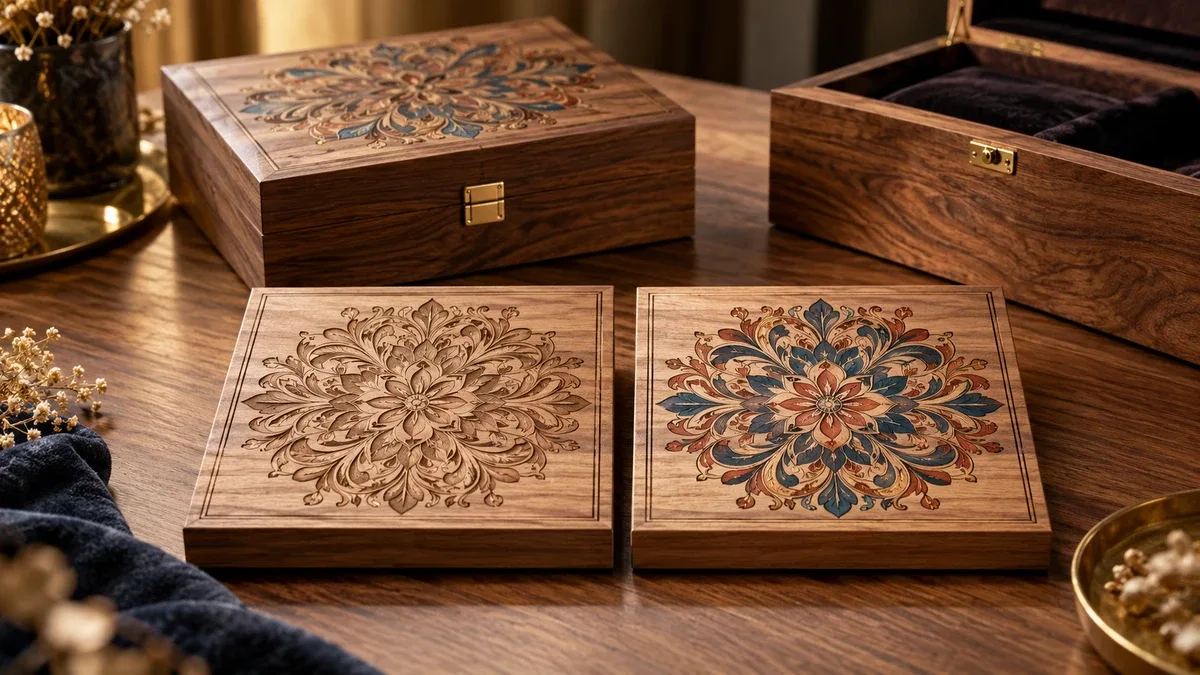
Laser engraving creates a mark in the wood surface, while UV printing applies artwork in ink. Choose between them by color needs, detail, material and finish. Approve final-size physical proofs on the proposed surface, including the smallest critical text and the expected cleaning or handling conditions.
When engraving makes sense
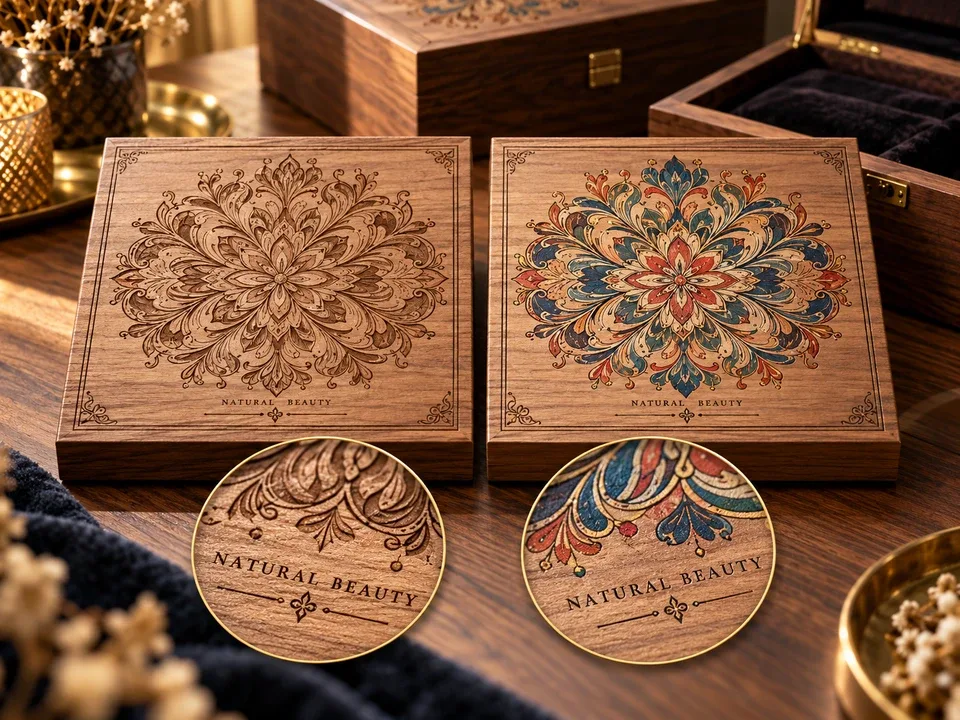
Engraving is useful when a natural, single-tone mark suits the product. The shade and sharpness depend on the material and settings. Fine lines can disappear in strong grain; very small text may be difficult to read. Give the supplier vector artwork and ask to see the smallest important text or line on a real sample. If the surface is already coated, verify the result on that coated version.
When printing makes sense
UV printing can reproduce colored graphics and more complex artwork. Its appearance depends on the substrate, surface preparation and ink treatment. Test the exact color on the proposed wood and finish. On darker surfaces, ask how the supplier will maintain the intended color appearance. Review registration at edges and on assembled products, not just a flat sample panel.
A fair sample comparison
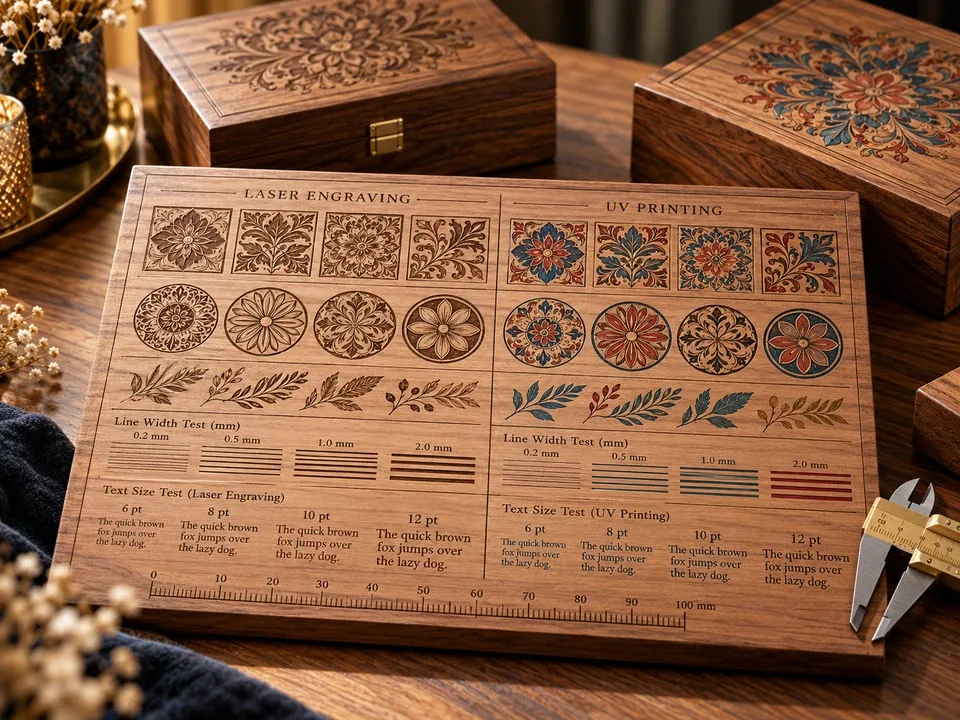
Use the same logo size and location for both methods. Photograph each sample in daylight and under typical retail lighting. Inspect legibility, hand feel and how the mark interacts with the grain. If the item will be handled or cleaned frequently, agree on a relevant durability check with the supplier. Do not accept a generic promise of permanence without a product-specific test.
The quote should name the artwork file, mark dimensions, location, color or engraving effect, sample charge and any setup requirement. A branding decision also affects carton labeling and repeat-order consistency, so retain an approved reference sample.
Details to settle before requesting a quote
| Buyer decision | Information to provide |
|---|---|
| Artwork | Editable logo with final dimensions, colors and smallest required text. |
| Surface | Actual wood and finish, including dark or strongly grained samples. |
| Comparison | Same artwork position and scale in both methods; agreed handling checks. |
Can I approve a logo using only a digital mockup?
A mockup establishes size and placement but not wood contrast, ink appearance or finished-surface behavior. Approve a physical proof on the production material. If the material or finish changes, review the mark again before a repeat run.
Related purchasing decisions
Small Text on Laser-Engraved Wood: Approve Legibility at Real Size
Approve small engraved text at its final size on the intended wood and finish. Test critical letters across representative grain and contrast, then adjust type, size or placement if needed. A magnified digital logo cannot establish readable production output.
| Buyer decision | Information to provide |
|---|---|
| Text | Critical versus decorative copy and exact final dimensions. |
| Surface | Actual material, grain range and coating. |
| Proof | Readable physical mark with measured placement. |
Is there one minimum font size for all wood engraving? No universal value is appropriate across materials, fonts, finishes and equipment. Ask for a final-size proof of the smallest essential text. Define acceptance against that readable sample rather than borrowing a generic number.
Run a controlled branding proof
Provide one approved artwork file and request the same final logo size on both samples. Keep material, finish and position consistent so the method is the variable being compared.
| Approval point | What to record |
|---|---|
| Readability | Smallest required letters and symbols at ordinary viewing distance |
| Appearance | Color requirement, grain interaction and acceptable contrast |
| Surface | Touch and visual effect on the complete finished product |
| Use | Agreed handling or cleaning evaluation where relevant |
| Repeatability | Artwork revision, dimensions and retained physical proof |
If full-color artwork is essential, state that before comparing techniques. If a natural single-tone mark is the priority, state that too. Do not use a generic claim that one method is always cheaper or more durable; ask suppliers to price and demonstrate the specific mark and use case.
Discuss your specification with Woodencraftfactory
Start with the three decisions above: artwork, surface, comparison. Include your reference image or drawing, quantity by variant and destination. Mark unresolved details as “please advise” so the inquiry can identify the decisions still needed.
Request a Quote to discuss the proposed design and its feasibility, or review our laser-cut wood products first.
Related reading: Laser-cut wood production considerations.